

The Mission
New Christa is an improved version of the original Christa rocket, designed to offer better reusability and reliability. The main objective of the mission is to act as a launcher for CanSats, with the capacity to carry up to 6 payloads (CanSats) per launch, housed in a gondola system during ascent.
This first launch served to validate its operational performance and certify the rocket for use in future European Space Agency (ESA) CanSat competitions.
The Legacy Behind the Name
Every rocket developed by Cosmic Research carries a profound legacy in its name. The New Christa mission is a direct tribute to Christa McAuliffe, the American secondary school teacher and astronaut who tragically lost her life in the Space Shuttle Challenger disaster in 1986. McAuliffe was not just a NASA crew member; she represented a passion for science outreach and a desire to open the doors of space and science to new generations from the classroom.

The Rocket
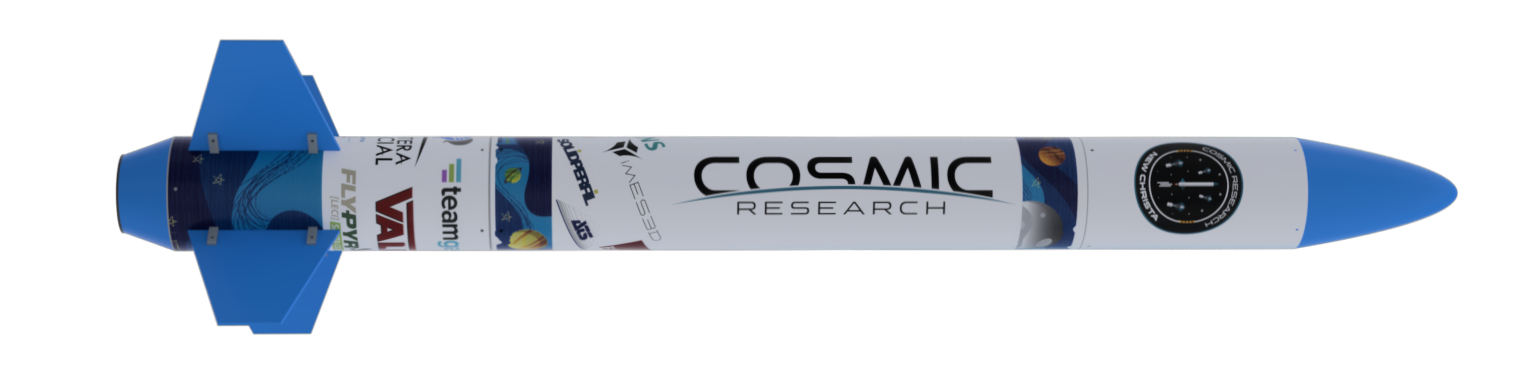
1.662 m
ROCKET LENGTH
154 mm
OUTER DIAMETER
10.079 kg
LIFT-OFF WEIGHT
500 m
APOGEE
Propulsion
The thrust comes from a commercial solid-propellant motor from Cesaroni Technology. The motor provides a burn time of 1.7 seconds with a maximum thrust of 937.3 N, supplying all the energy needed to complete the planned trajectory.
Structures
The structure uses a high-density design to optimise aerodynamic stability, which is complemented by four symmetrical fins and a boat-tail.
Recovery
New Christa has been designed with a dual redundacy design to ensure safe deployment:
- A drogue parachute deployed at apogee
- A main parachute deployed at 150 meters above the ground
Avionics
New Christa features its own SRAD avionics system called Lovelace (in honor to first programmer in history Ada Lovelace), integrated into a custom board that centralises all rocket management.
Reads all necessary data such as acceleration and altitude and stores it in a flash card and a FDR to ensure data storage.
Additionally, the main microprocessor is capable of processing the sensor data, automatically detecting apogee and activating the separation of the rocket that initiate the deployment of the recovery system.
Reliability and optimisation
The New Christa’s design takes a leap forward in robustness and engineering. Significant redundancy improvements have been integrated into critical systems to ensure the safe deployment of the parachutes.
In parallel, we have simplified its manufacture to the utmost, reducing construction complexity to achieve a much more efficient, practical and easy-to-use rocket on the launch pad.
Launch site
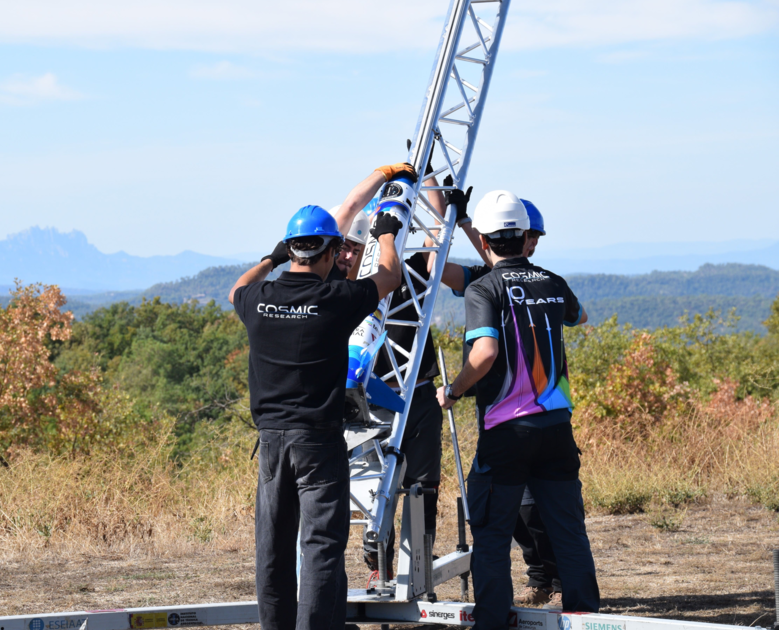
Barcelona Drone Center in Moià, Spain (41°48’54“N 2°05’42”E), served as the launch base for the New Christa mission.
The launch was carried out on September 10, 2026, to take advantage of the region’s optimal summer weather while avoiding the risk of fire. The typically calm winds and clear skies of these months were crucial for maintaining continuous visual tracking and ensuring the successful recovery of the rockets across the terrain.
Mission Collaborator

As part of an aerospace outreach day at the Escola Balmes, the pupils collaborated on the aesthetic design of the rocket by contributing their own sketches. These initial proposals were digitised and technically adapted to become the official decals that now adorn the fuselage of the New Christa.