
The Mission
Conceived as a “Baptism of Fire”, this mission was the starting point for Cosmic Research. The goal was to gain vital experience in the main subsystems of a rocket: fuselage, engine, electronics and recovery.
The campaign was designed to achieve Level 1 and Level 2 certifications from the Tripoli Rocketry Association (TRA), establishing the legal and technical foundations for the association’s future projects. It was based on the construction and launch of a commercial kit, specifically the AGM-33 Pike model from the Madcow Rocketry brand.
The Legacy Behind the Name
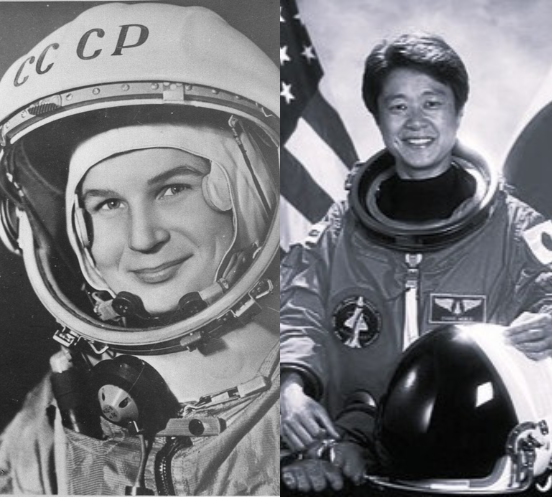
Every rocket developed by Cosmic Research carries a profound legacy in its name. As our first vehicle, this rocket began our significant tradition of dedicating our launch vehicles to pioneering women in aerospace history. It was originally named Valentina in honour of Valentina Tereshkova, the first woman in history to fly into space. Reflecting the evolution of this inaugural project, the fuselage was later repainted by urban artist @acidcollapse and renamed Mukai, paying tribute to Chiaki Mukai, the first Japanese woman in space and the first Asian astronaut to fly aboard the Space Shuttle Columbia.
The Rocket
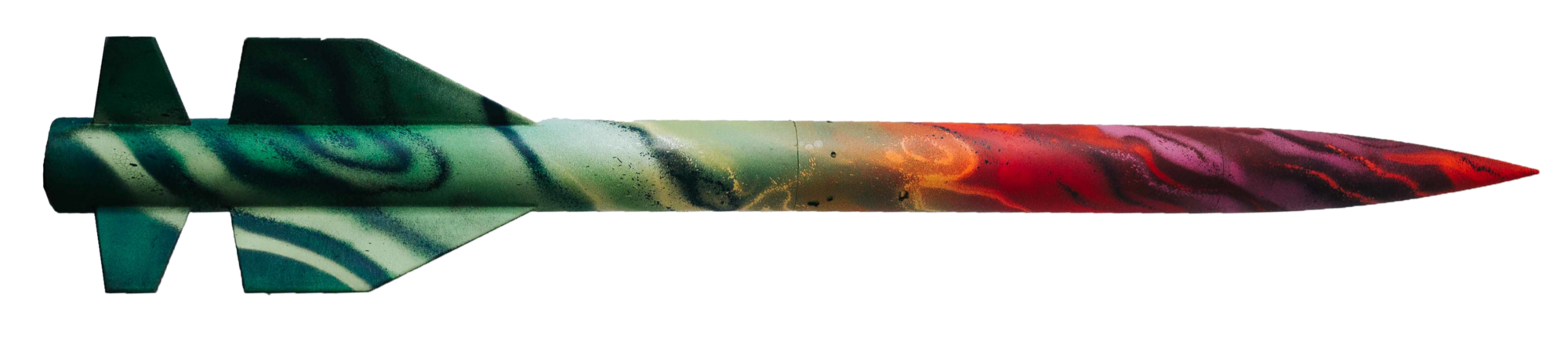
1.69 m
ROCKET LENGTH
101 mm
OUTER DIAMETER
1.7 kg
LIFT-OFF WEIGHT
- Parameter
- Maximum velocity
- Apogee
- Recovery system
- Electronics
- Flight 1 – L1
- ~0.3 Mach
- ~300 m
- Simple Parachute
- None
- Flight 2 – L2
- ~0.6 Mach
- 900 m
- Drogue + Main Parachute
- Redundant flight computers
Propulsion
Valentina utilized an Aerotech H-148R for its first flight and a J-350W for its second.
Recovery
The Valentina recovery system was designed to ensure the safe return of components depending on engine power.
On the first flight, the rocket had a single deployment with a single parachute.
For the second flight, a dual deployment system was implemented to reduce lateral drift during descent. This configuration consisted of a drogue parachute, which was released at apogee, and a main parachute, programmed to open at a height of 150 meters above the ground.
Avionics
Building on the mechanical success of the first launch, the second one introduced a sophisticated electronic flight management system.
This setup featured dual redundancy, combining in-house innovation with commercial hardware to monitor flight progress and ensure the safe, automated deployment of the recovery systems.
Launch site
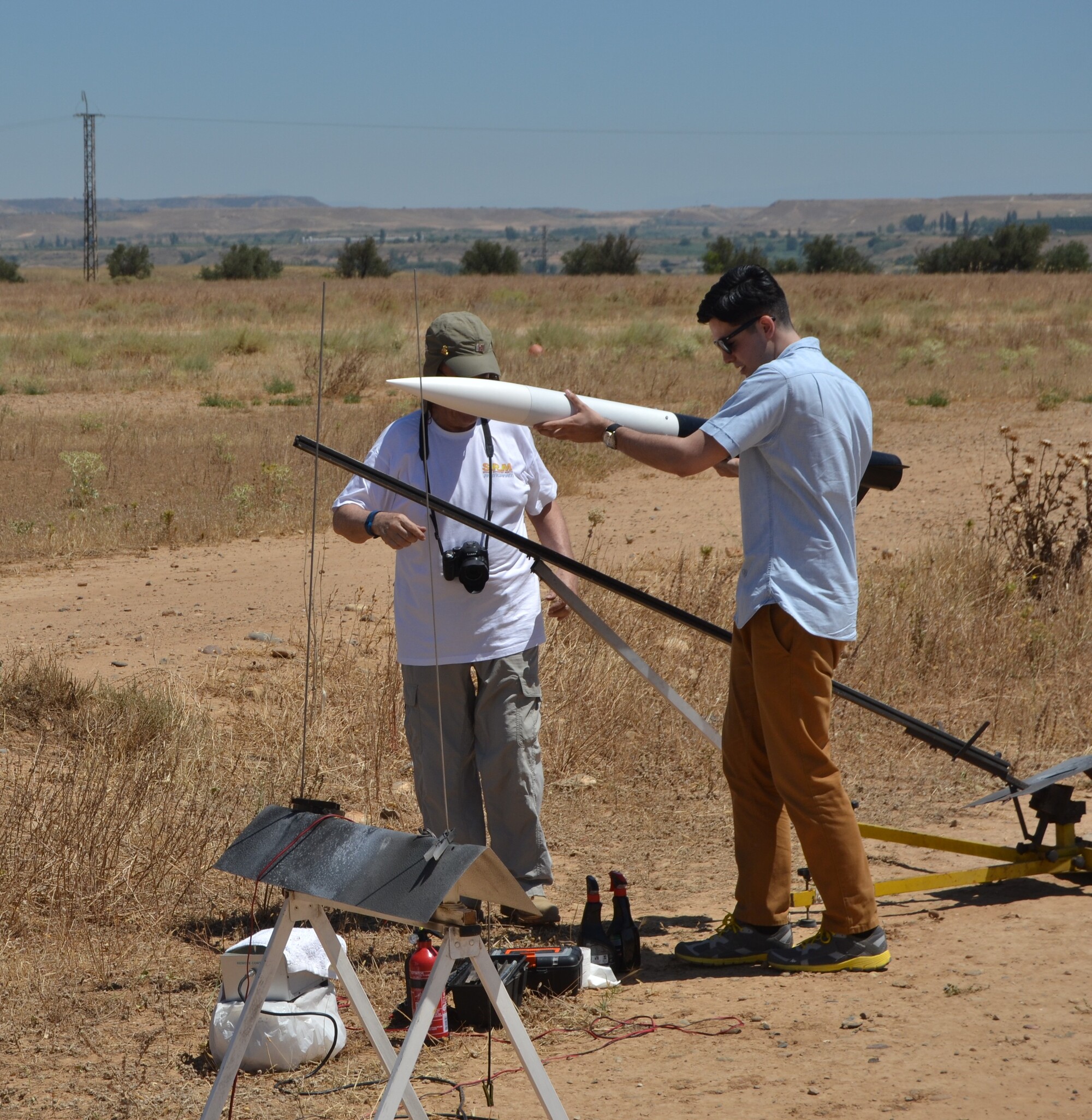
The Aerocinca aerodrome in Alcolea de Cinca, Spain (41°44’03″N 000°06’27″E), served as the primary operations base for the Valentina missions. This strategic location was made available through the vital support and collaboration of the Spain Rocketry club, providing a dedicated environment for high-power launches.
The launches were scheduled during July and August to take advantage of the region’s optimal summer climate. The characteristic calm winds and clear skies of these months were crucial for maintaining continuous visual tracking and ensuring the successful recovery of the rockets across the terrain.
Mission Collaborator

SpainRocketry is a Spanish amateur rocketry club that hosts and organizes launch campaigns under the framework of the international Tripoli Rocketry Association. Through its infrastructure and launch sites, the club supports hobbyists, research groups, and student teams in safely testing and flying high-power rockets, while promoting the development of rocketry in Spain. The Weber mission was launched during one of their organized campaigns at the Fuentelahiguera launch field.
@acidcollapse is a Sabadell-based urban artist who transformed the original flight fuselage into a unique piece of art, blending the worlds of aerospace engineering and contemporary street art. Through this collaboration, the rocket was reborn with a new aesthetic identity, leading the team to officially rename the vehicle as Mukai. His work not only commemorates the mission’s success but also symbolizes the project’s transition from a technical prototype to an iconic element of the team’s legacy.